
A radical healthcare idea: insurance should only be insurance

A simple visit to a primary care doctor costs a patient anywhere from $27 to $600.
The actual cost including discounts, insurance reimbursements, government subsidies, and third-party payments makes it difficult to decipher the true number.
That's the major problem for healthcare in America: No one knows the true cost because prices depend on who's actually paying. Somebody else is always footing the bill.
For an American with employer-based health insurance, the average is $224. Sometimes it can be reduced to a $27 co-pay. For those paying with cash and no insurance, the average is $160. For older Americans on Medicare, veterans, disabled patients or those near the poverty line with children on Medicaid, approximately 36% of the population, the cost varies even more depending on the provider and whether they accept government reimbursements.
Rather than use insurance as it was intended – for major medical expenses and emergencies – we treat insurance as a means for paying for routine care. More than 50% of Americans have health insurance through their jobs, so losing that job or changing it means you're SOL.
We pay premiums, either on independent plans or through our employer, and then use our "insurance" to cover ordinary visits. This betrays the idea of what insurance is supposed to be: buying protection against risk and catastrophic financial loss.
The 'Insurance Piggy Bank Delusion'
I've written at length about what I've dubbed the "insurance piggy bank delusion" because it's a strange economic arrangement that would make no sense in any other sector of the economy.
We pay premiums for a healthcare insurance plan, our employers contribute for a tax deduction, taxes are collected in our paychecks to fund government health insurance programs, and armies of bureaucrats scrutinize receipts and bills to decide how much they're willing to fork over. We put money into many piggy banks, and we suffer under the delusion that we can empty them at-will.
What makes it worse is that we have no price transparency because of the massive amounts of insurance premiums and healthcare subsidies that exist in the system.
Our system is defined by the opacity of healthcare prices, the burgeoning bureaucracies in government departments and insurance companies that riffle through claims, and the endless stream of discounts, rebates, and reimbursements that Americans have to ask permission to use just to pay medical bills that would probably just be cheaper if we used a Visa card.
When a patient visits a health provider and goes to pay, why is anyone else involved? Why is an insurance company or a government agency inserted into this relationship?
Insurance should primarily protect patients against costs they cannot reasonably bear themselves. Routine primary care, selected tests and predictable services can often be purchased directly, through a membership or with patient-owned savings.
When it comes to serious injuries, life-threatening incidents, and general catastrophes, we know the ultimate bill will be high. Ambulance costs, hospital intakes, surgeries, rounds of testing, follow-ups, and consultations with specialists. These are the situations where healthcare insurance is not only appropriate, but precisely what it's supposed to be for.
Rather than paying $65,000 for a complete hospital stay after a work injury or car accident, we tap into our insurance to avoid the risk of financial ruin. But we shouldn't be using the same insurance to cover a $140 physical.
But to make this work, we need transparent prices and robust competition among providers. We also need a total mind-shift about what insurance is supposed to be used for.
Healthcare inflation
Anyone in policy has surely seen AEI's "chart of the century" that measures the difference in prices of various good and services from January 2000 to June 2022. Hospital services, college costs, and medical services have gotten anywhere from 130% to 250% more expensive, while computer software, TVs, and kids' toys have all gotten more affordable.
The chart shows the difference in government-dominated industries versus those that mostly operate on private enterprise. It's stark.
But let's look at a chart of my own making that analyzes the Consumer Price Index for healthcare-related numbers nominally over time:
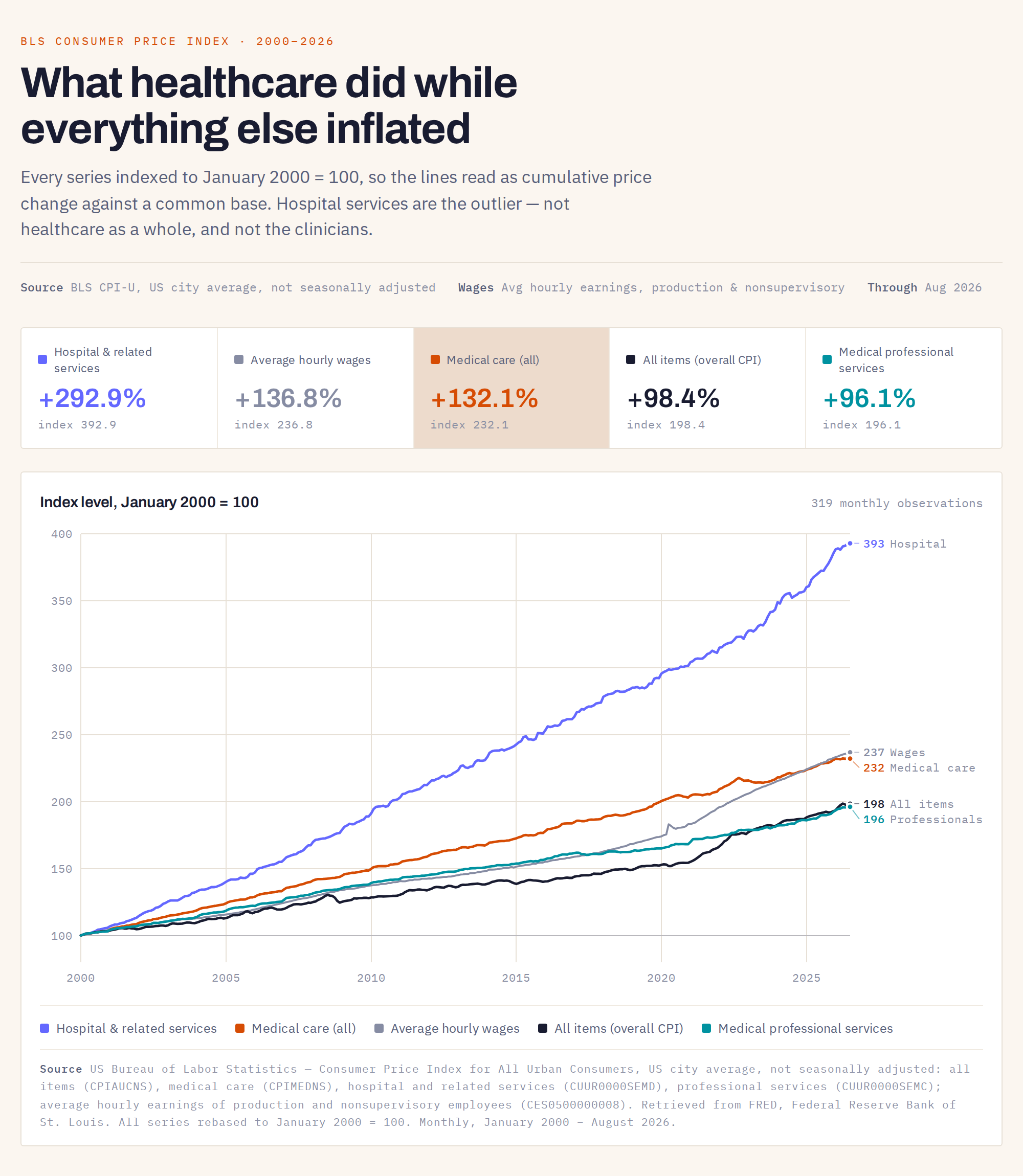
No matter how you look at it or try to adapt general market inflation into the mix, this chart hurts. Hospital-related services are sky-high. Why has this happened?
There are several macro and micro arguments and theses that could explain why healthcare costs are so much higher today than just 25 years ago. Here are just a few.
**
1. Insurance increasingly functions as prepaid healthcare, not simply risk protection
When routine care goes through insurance or a government insurer, the patient sees a co-pay or discount price rather than the full price. The provider negotiates with a payer rather than competing directly for the patient’s dollars. The financial consequences return later through premiums, wages or taxes that hike up all other prices.
This dulls price sensitivity to the prices of additional services and reduces the rewards for choosing cheaper providers. In other words, patients become numb to whatever price is quoted because somebody else will always pay.
The RAND insurance experiment found that patients used less care when they paid a share themselves rather than having insurance cover it.
Overall, we've seen direct payment for health services fall dramatically.
Out-of-pocket spending fell from close to half of health spending in 1960 to 11% of national health expenditures in 2024 — $557 billion out of $5.3 trillion. Private insurance now covers 31%, Medicare 21%, Medicaid 18%.
And this is far from emergency medical spending.
2. Ordinary transactions are administratively expensive
Instead of a provider offering a service at an agreed price, an appointment can generate eligibility checks, coding, claims, adjudication, denials, appeals and patient collections. Different payer rules multiply that work and involve more parties than ever before. An entire administrative layer is introduced and everyone skims off the top.
The relationship between the patient and the medical provider becomes un-tethered, ballooning costs and fees all along the chain.
At my direct primary care clinic in Charlotte, North Carolina, there is no insurance accepted and everything is settled through cash payments. The prices are written in ink in the waiting room.
The doctor has a receptionist to book appointments and file patient histories, other doctors on call to cover additional shifts, and a nurse to help with tests. That's it. There is no large administrative staff beyond the receptionist because there are no claims to chase up. All for a monthly direct primary care fee that's under $100.
3. Government subsidizes the payment system more consistently than it expands affordable supply
Employer tax preferences favor compensation through health benefits. That's just how the system has been built up over time. That makes employer-selected insurance more attractive relative to taxable wages and individually purchased alternatives.
But it also separates the person choosing the plan from the patient receiving care, and introduces an employer as a key stakeholder in your health arrangements.
Public coverage and premium subsidies increase purchasing power, but they do that across the entire market for healthcare. Where supply cannot expand readily, additional purchasing power can translate partly into higher prices, more service intensity or longer waits rather than proportionately more accessible care.
There is historical evidence that insurance expansion changes the entire delivery system: research on Medicare’s introduction found substantial increases in hospital spending, including responses beyond individual patients’ utilization. Just imagine those numbers today.
4. Government programs can crowd out private financing
Research on Affordable Care Act coverage expansions finds some evidence of Medicaid crowding out private coverage among low-income people. It would be great to have additional research here, as well as the impact of Medicare spending.
**
America has spent decades making it easier to pay for healthcare through somebody else and harder to buy it in a competitive market. Those are bad incentives that create a convoluted system in which no one knows the real price.
We subsidize coverage, restrict supply and reward providers for navigating reimbursement systems. When the bill rises, we subsidize it again. It's a vicious cycle.
My argument is simple. Insurance should primarily protect patients against costs they cannot reasonably bear themselves. Routine primary care, selected tests and predictable services can often be purchased directly, through a membership or with patient-owned savings, and they should be. Patients should use tax-advantaged accounts to make this happen, and governments should make this easier rather than more difficult.
Transparent prices and competition are necessary to make this work, and there is plenty more to do there.
There is also a lot of heavy lifting that should be done on the health policy front. Reforming pharmacy benefit managers, protecting IP on drugs, opening up insurance markets across statelines, and limiting the expansion of government healthcare programs that push up costs for everyone else.
Practical tips
Having thought about this plenty and explored the healthcare ecosystem for better technology, subscriptions, and services, I have some idea about practical tips to make your healthcare arrangements more affordable.
These don't work for everyone, but they should at least be explored.
Buy insurance for the catastrophe, not the appointment.
Higher deductibles are your friend because they lower your monthly premiums. They also reserve reimbursements for when you actually have medical emergencies. I've written about some plan suggestions on my own website, but the market is always improving.
Consider alternative models like health-sharing ministries, direct primary care doctors, and concierge medicine.
Websites like DPC Frontier show you where to find a local direct primary care provider that you pay monthly and have easy access for appointments that you pay in cash. Services like CrowdHealth and the bountiful list of health-sharing ministries grant you an alternative to the larger healthcare insurance bureaucracy.
Use your Health Savings Account.
If you are eligible, invest heavily in your tax-advantaged Health Savings Account. Not only do you get tax deductibility, but you also are able to tap this account for health spending at any time.
The list of services that are HSA-eligible is also growing, so take a peek at your Amazon shopping list for what you could purchase using your HSA.
You can also now use your HSA for your monthly direct primary care subscriptions, thanks to some important congressional reforms.
Ask for cash prices before you pay.
Asking a health provider for their cash prices (without insurance) can lead to immediate discounts. This will vary by provider, but doctors' offices are much more inclined to accept direct payment than deal with additional insurance paperwork. This won't count toward your deductible, but it could lead to more cost savings and less hassle overall.


Member discussion